DIS2020
More than Human Centred Design
Performance and Design Exhibition
Stymphalian Birds—Exploring the Aesthetics of A Hybrid Textile
Audrey Briot, DataPaulette, France.
Cedric Honnet, MIT Media Lab, United States.
Paul Strohmeier, Saarland Informatics Campus, Saarland University, Germany.
Paper available at the ACM digital library
Stymphalian Birds explores the aesthetics and the societal impacts of a hybrid textile at the crossroads of electronics and haute couture. The exhibited textiles are hybrid in various ways. They combine traditional handcrafts with digital technologies, chemical processes and elements created by nature. These four different approaches seamlessly connect traditional featherwork and materials science. The resulting textiles provide a rich multi-sensory experience: complex haptic interactions with feathers and textiles are sonified in acoustic soundscapes.

Stripping
The rooster tail feathers were stripped to both mimic filoplumes and for the aerial and playfulness of the resulting shape.

Pyrrole and Iron (III) chloride
The feathers were polymerized with pyrrole and Iron (III) Chloride.

Polymerization
The Iron (III) Chloride is added inside the bath after the pyrrole.

End of the polymerization
The feathers were prepared using dyeing methods, traditional featherwork and polymerization.

Conductive feathers
This process make them electrically conductive.

Wrapping
The feathers are connected using the standard electronic method of wire wrapping using a hand wrapping tool and a very thin insulated wire.

Embroidery
The connected feathers are laid out according to the circuit and the wires are chain stitched following the French embroidery Lunéville technique.

Electronic
Each wire is then wrapped and soldered to a MPR121 capacitive touch controller board. The touch controller is read by an Arduino Nano microcontroller which controls a DFPlayer Mini MP3 module. Most recently to give versatility to the textiles, these components have been replaced by an ESP32 and a combination of 4 MPR121 capacitive touch controller boards.
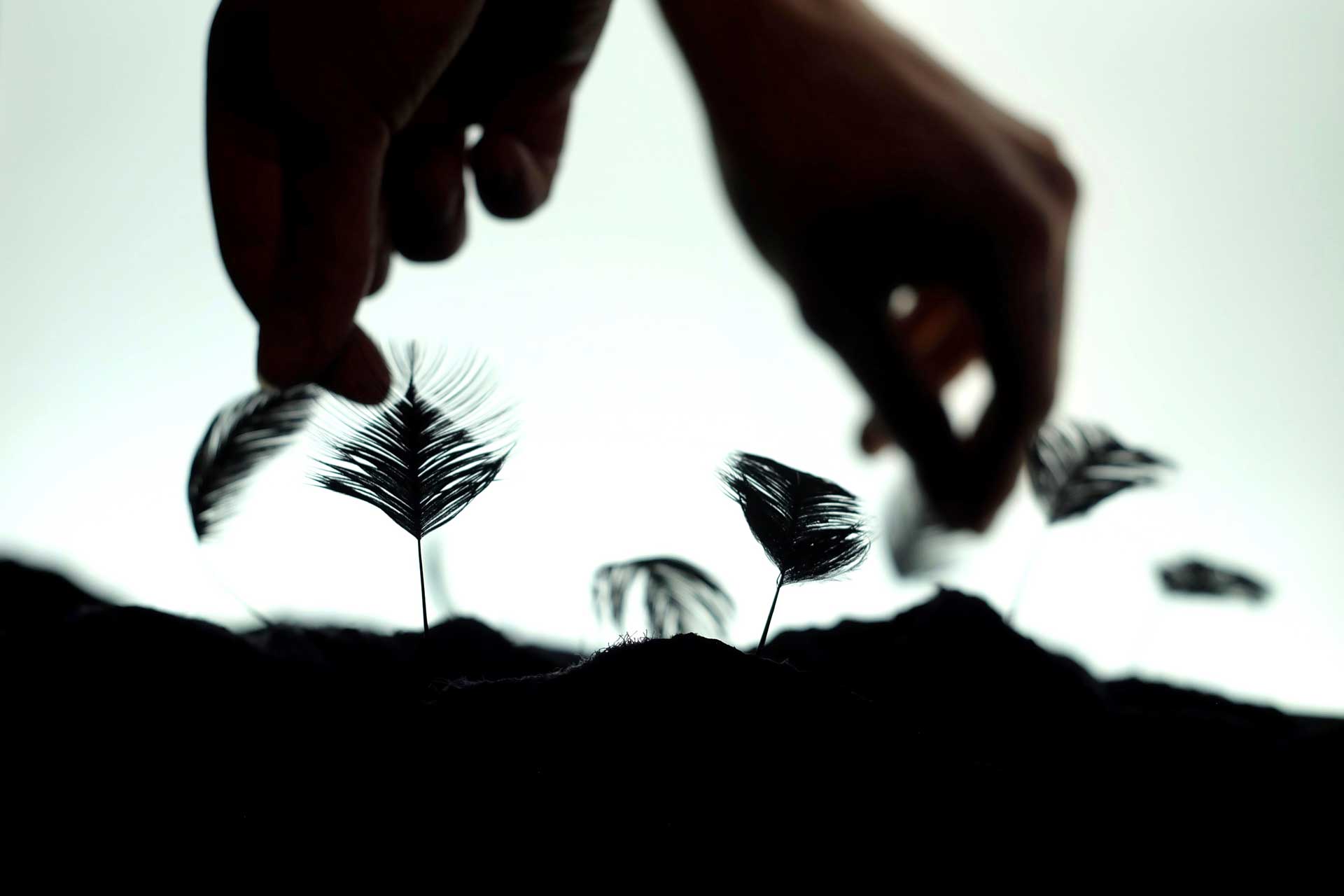
Final Image Title
Another image Caption

Interactions
These progressive steps in electronic and textile design enable the creation of a standalone system in which the feathers are sensors which react to touch by emitting sounds. Users can interact with multiple feathers at the same time to create a melody.